Songkran Meaning
In short
The Songkran meaning is "movement", from the Sanskrit sankranti, the day the sun moves into Aries.
What does Songkran mean?
Songkran means "movement". The word comes from the Sanskrit word sankranti, and it names the day the sun moves from Pisces into Aries, the first sign of the zodiac. In Thailand, that move marks the start of the traditional Thai New Year.
So the Songkran meaning is a new start: the sun moves into a new sign, and people wash away the old year with water and welcome the new one with blessings. Songkran 2027 is Tuesday 13 to Thursday 15 April, three public holidays across Thailand.
Songkran meaning at a glance
The word
- Answer:
- From the Sanskrit sankranti, "movement"
What moves
- Answer:
- The sun, from Pisces into Aries
What it marks
- Answer:
- The traditional Thai New Year
What the water means
- Answer:
- Cleansing, respect and good luck
Songkran 2027
- Answer:
- Tue 13 to Thu 15 April, public holidays
UNESCO
- Answer:
- On the Representative List of the Intangible Cultural Heritage since 6 December 2023
Where does the Songkran meaning come from?
The meaning of Songkran comes from the sky. Each year in mid-April, after the rice harvest, the sun passes into Aries, and the old Thai calendar counted that as New Year. Families came together, and the new year began with respect for parents, elders and the Buddha.
A famous old tale adds the Songkran Lady, or Nang Songkran. In the story, a god called Kapila Brahma has seven daughters, and each year one of them carries out the New Year duty. Which daughter it is depends on the day of the week Songkran falls on, so every year has its own Songkran Lady.
Want to see the old side of Songkran as well as the water? Ask Tanner.
- Songkran means
- "Movement", from the Sanskrit sankranti
- What it marks
- The sun moving into Aries: the Thai New Year
- Songkran 2027
- Tue 13 to Thu 15 April, public holidays
- The water means
- Cleansing, respect and good luck
- UNESCO
- Listed 6 December 2023
- Greeting
- Suk San Wan Songkran
Which Songkran traditions can you join?
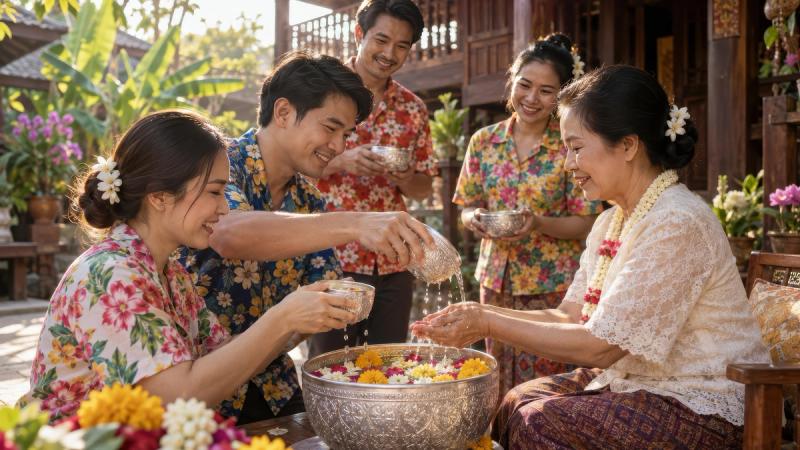
The Songkran traditions are about family, respect and good luck: pouring water over elders' hands, bathing Buddha images, making merit, building sand chedis and splashing water for luck. Visitors are welcome at most of them, as long as you join in with a smile and a little respect.
Go to a temple in the morning, watch first, and follow what the Thai families do. In the afternoon, the streets are yours. Plan it with Tanner.
Songkran traditions also change from region to region, so each city has its own flavour:
- The north: in Chiang Mai, Songkran is Pi Mai Mueang, the Lanna New Year, with temple visits inside the Old City and water around the moat.
- Near Bangkok: Phra Pradaeng keeps the Mon Songkran, held after the main holiday.
- The northeast: Khon Kaen fills Khao Niao Road with one big moving crowd.
- The south: Hat Yai keeps the water going late into the night.
- The east coast: Pattaya holds Wan Lai, its own late Songkran, a few days after the holiday.
Songkran traditions and customs: what happens and how to join
Rod nam dam hua
- What happens:
- Younger people pour scented water over the hands of parents, teachers and elders, say sorry for the past year and get their blessing
- Can visitors join?:
- Yes, if a Thai family or host invites you
Bathing Buddha images
- What happens:
- People pour scented water gently over Buddha images at the temples
- Can visitors join?:
- Yes, at temples: follow the families and pour gently
Merit-making
- What happens:
- Families give food to monks in the morning and visit the temple
- Can visitors join?:
- Yes: dress modestly and follow the line
Sand chedis
- What happens:
- People carry sand into the temple and build small sand pagodas
- Can visitors join?:
- Yes, often: ask at the temple
Remembering the family
- What happens:
- Merit is made for loved ones who have passed away
- Can visitors join?:
- Watch quietly
Water splashing
- What happens:
- Friends and strangers splash each other in the street for luck and fun
- Can visitors join?:
- Yes: splash the people who are playing
Why is water the heart of Songkran?
Water is the heart of Songkran because it stands for cleansing, respect and good luck. Pouring water washes away the bad luck of the old year and wishes people a fresh, cool start to the new one. April is the hottest month in Thailand, so water is a gift too.
That is how a gentle blessing became the famous Thailand water festival. At home and at the temple, water is poured softly. On the street, it comes by the bucket. The idea is the same: a happy, lucky new year.
The one rule: splash the people who are playing, and leave monks, older people and anyone not joining in dry. Read what to wear for Songkran before you go.
What happens on each day of Songkran?
The three days of Songkran each have their own name and job. 13 April is Maha Songkran Day, 14 April is Wan Nao, and 15 April is Wan Payawan, also called Wan Thaloeng Sok, the day the new year begins.
- 13 April, Maha Songkran Day: the sun moves into Aries and the old year ends. It is also National Elderly Day.
- 14 April, Wan Nao: families get ready for merit-making and carry sand into the temple for the sand chedis. It is also Family Day, and the old belief says no quarrels today, for a lucky year.
- 15 April, Wan Payawan (Wan Thaloeng Sok): people go to the temple, make merit for loved ones who have passed away, and do rod nam dam hua with the elders.
Every city plays it a little differently. See every city's dates on the Songkran 2027 page.
The three days of Songkran 2027
Maha Songkran Day
- Date in 2027:
- Tuesday 13 April
- What it means:
- The sun moves into Aries; the old year ends
- What people do:
- Temple visits, bathing Buddha images; National Elderly Day
Wan Nao
- Date in 2027:
- Wednesday 14 April
- What it means:
- The day in between
- What people do:
- Sand chedis, getting ready for merit; Family Day
Wan Payawan (Wan Thaloeng Sok)
- Date in 2027:
- Thursday 15 April
- What it means:
- The new year begins
- What people do:
- Merit for loved ones, rod nam dam hua, blessings from elders
Why did UNESCO list Songkran?
UNESCO added Songkran in Thailand to its Representative List of the Intangible Cultural Heritage of Humanity on 6 December 2023. The listing honours Songkran as a living tradition that brings families back together, honours older people and ancestors, and helps whole communities forgive and start again.
The listing names the same things you'll see in April: pouring water for cleansing, respect and good fortune, bathing important Buddha images, splashing family and friends, folk plays, games, music and big family meals.
Songkran has cousins across the region too. Read Songkran vs Thingyan and Asia's other water New Years.
How do you say Happy Songkran in Thai?
To say Happy Songkran in Thai, say "Suk San Wan Songkran" (สุขสันต์วันสงกรานต์), which means "Happy Songkran Day". You can also say "Sawasdee Pi Mai" (สวัสดีปีใหม่), which means "Happy New Year". Both are good-luck greetings, and Thais love to hear them.
Add "khrap" if you're a man or "kha" if you're a woman to make it polite, and smile big: you'll probably get splashed right after.
Songkran greetings to use in 2027
Suk San Wan Songkran
- In Thai:
- สุขสันต์วันสงกรานต์
- What it means:
- Happy Songkran Day
- When to use it:
- Any time from 13 to 15 April
Sawasdee Pi Mai
- In Thai:
- สวัสดีปีใหม่
- What it means:
- Happy New Year
- When to use it:
- With friends, hosts and elders
Khrap / Kha
- In Thai:
- ครับ / ค่ะ
- What it means:
- The polite ending (men / women)
- When to use it:
- At the end of any greeting
Where can you see Songkran traditions?
You can see Songkran traditions all over Thailand from 13 to 15 April 2027, and some cities start early or finish late. Temples are busiest in the morning; the water fights start after lunch.
- Songkran in Bangkok: temple mornings, then Silom and Khao San Road.
- Songkran in Chiang Mai: the Old City temples and the moat, the most traditional big Songkran.
- Khon Kaen Songkran: Khao Niao Road in the northeast.
- Phra Pradaeng Songkran: the Mon Songkran next to Bangkok, after the holiday.
- Hat Yai Midnight Songkran: the south's water fight that goes into the night.
- Pattaya Wan Lai: the late water fight after the holiday.
- Songkran in Phuket and on Koh Samui: Songkran on the beach.
Getting around is easy with a luxury van and driver from ฿6,500 for 10 hours, for up to 4 guests, and a private pool villa from ฿18,500 a day makes a cool base. Plan it with Tanner.
What's the Songkran meaning in short?
- Songkran means "movement": the sun moves into Aries, and the Thai New Year begins.
- Water stands for cleansing, respect and good luck.
- The three days: Maha Songkran Day (13 April), Wan Nao (14 April), Wan Payawan (15 April).
- Say "Suk San Wan Songkran" for Happy Songkran Day.
- Songkran 2027: Tuesday 13 to Thursday 15 April, public holidays. Checked November 2026.
Read Songkran 2027, the what to wear for Songkran and Songkran in a pool villa.
Plan it with Tanner.
Questions
Songkran meaning: questions
What does Songkran mean?
What is Songkran?
Is Songkran the Thai New Year?
When is Songkran 2027?
Why do people throw water at Songkran?
What is rod nam dam hua?
What are the three days of Songkran called?
What is a sand chedi?
Who is the Songkran Lady?
Is Songkran celebrated outside Thailand?
How do you say Happy Songkran in Thai?
Keep reading
Sources
- THAILAND.GO.TH (Government Public Relations Department): Get to know the Thai tradition of Songkran: Sanskrit 'movement'; 13 Apr Maha Songkran (sun Pisces to Aries); 14 Apr Wan Nao, sand pagodas, no quarrels; 15 Apr Tha Loeng Sok / Phaya Wan, merit for the departed, Rod Nam Dam Hua
- UNESCO Intangible Cultural Heritage: Songkran in Thailand, traditional Thai New Year festival (Representative List, 18.COM, 2023): sun into Aries; water = cleansing, reverence, good fortune; bathing Buddha images; elders, ancestors, family
- Thailand Trade and Economic Office, Taipei (MFA), 14 May 2026: The folktale behind Songkran: Sankranti = movement of the sun into Aries; Kapila Brahma's seven daughters, the Nang Songkran, one per year by weekday
- Thailand Trade and Economic Office, Taipei (MFA): Maha Songkran Festival 2025: Songkran derives from Sanskrit 'Sankranti', meaning movement
- Bank of Thailand: Financial institutions' holidays 2027 (Notification 37/2569): Songkran 13–15 April
- Embassy of Belgium in Thailand: Songkran greetings: 'Sawasdee Pi Mai' and 'Suk San Wan Songkran' (Happy Songkran Day)
Plan it